
How Do I Estimate Labor Hours Accurately for a Service Contract?
Jan 14, 2026
Estimate labor hours by breaking the project into specific tasks, applying historical data from similar jobs, and adding a 15-20% buffer for unforeseen complications. Use the 3-Point Estimation method: calculate your best-case hours, worst-case hours, and most-likely hours, then apply this formula:
(Best + 4×Most Likely + Worst) ÷ 6 = Estimated Hours.
This approach prevents both under-bidding (which costs you money) and over-bidding (which loses you contracts). Most service contractors who estimate poorly either forget about setup and cleanup time, underestimate complexity, or fail to account for client changes.
Master pricing and estimation with proven frameworks. The Unsexy Shop offers courses on service business pricing, labor estimation templates, and profitability systems, so you stop leaving money on the table and start winning contracts at rates that actually work.
The Task Breakdown Method for Hour Estimation
The most accurate estimates for trades and service businesses come from breaking contracts into granular tasks rather than guessing at the total.
Start by listing every distinct task, including setup, execution, cleanup, travel, and administrative work. Assign hours to each task using 15-minute increments for precision. Account for dependencies where some tasks can't start until others finish. Factor in team skill levels since a senior technician completes work 30-40% faster than a junior one.
For a commercial HVAC installation:
- Site preparation: 4 hours
- Equipment delivery and positioning: 3 hours
- Installation and connection: 12 hours
- Testing and calibration: 4 hours
- Documentation and client walkthrough: 2 hours
- Total core work: 25 hours
- Buffer (20%): 5 hours
- Final estimate: 30 hours
Using Historical Data to Improve Accuracy
Your past projects are the best predictor of future labor needs. Service contractors who maintain detailed time logs improve their estimation accuracy within the first year of tracking.
Track these metrics for each job:
- Actual hours versus estimated hours per job type
- Time per square foot for area-based work
- Time per unit installed for equipment or product work
- Complexity multipliers for difficult access, older buildings, or custom requirements
Use this comparison pattern: Similar project type + known variables = baseline estimate. A residential bathroom remodel typically takes 80-100 hours. Add 15% for second-floor locations, add 25% for homes built before 1970, and subtract 10% if no tile work is required.
The 3-Point Estimation Formula
The 3-Point method is a weighted average that accounts for uncertainty while avoiding wild guesses.
Define three scenarios:
- Best-case (Optimistic): Everything goes perfectly, no delays, ideal conditions
- Most-likely (Realistic): Normal conditions with typical minor issues
- Worst-case (Pessimistic): Major complications, access problems, or rework needed
Apply the formula: (Best + 4×Most Likely + Worst) ÷ 6
For a commercial cleaning project with a best case of 60 hours, most likely of 80 hours, and worst case of 120 hours: (60 + 320 + 120) ÷ 6 = 83.3 hours. Bid at 85 hours.
The weighted formula works because the "4×Most Likely" component prevents extreme scenarios from skewing your estimate while still accounting for them.
Hidden Time-Eaters That Destroy Estimates
Common overlooked tasks include:
- Client meetings and communication: Add 5-10% for projects requiring approval at multiple stages
- Travel between supply runs: Most contractors underestimate this by 40%
- Permit delays and inspections: Build in wait time, not just the inspection itself
- Learning curve on new equipment: First-time installations take 25-30% longer
- Rework from spec changes: Add 10-15% buffer for contracts over $10,000
Pure hands-on work typically represents only 70-75% of total project time. The remaining 25-30% disappears into coordination, waiting, problem-solving, and administrative tasks.
Adjusting Estimates Based on Project Variables
Complexity factors increase hours:
- Site accessibility: Difficult access adds 20-35% to labor time
- Working height: Each story above ground level adds 10-15%
- Client availability: Limited access windows increase hours by 15-25%
- Age of existing systems: Pre-2000 buildings often require 20% more time
- Custom versus standard work: Custom specifications add 30-50% to estimates
Team composition matters. One experienced technician plus one apprentice represents baseline hours. Two experienced technicians reduce the estimate by 15-20%. One solo technician increases the estimate by 25-30% because some tasks require two people.
Testing Your Estimates
Track estimated hours versus actual hours per project. Calculate your accuracy rate—within 10% is good, within 5% is excellent. Identify which project types you consistently over-estimate or under-estimate.
Run a monthly review process:
- Pull last month's completed projects
- Calculate variance: (Actual ÷ Estimated) - 1
- Identify projects with greater than 15% variance
- Determine cause: estimation error, scope creep, or unforeseen issues
- Update your baseline hours for similar future work
If you're consistently over 90% accurate, you're likely over-estimating. If you're under 70% accurate, your method needs refinement.
Common Estimation Mistakes to Avoid
The round number trap. Estimates of exactly 10, 20, or 40 hours suggest guesswork rather than calculation. Use specific numbers like 23 hours or 37 hours based on actual task breakdowns.
Forgetting admin time. Many contractors only estimate field time and forget pre-job site visits and measurements, creating quotes and documentation, post-job invoicing and follow-up, and supply ordering and coordination.
Optimism bias. Most contractors estimate based on ideal conditions. Real projects face delays, access issues, and minor complications 60-70% of the time. In 2025, 43% of construction projects alone experienced delays.
Scope creep vulnerability. Failing to define exactly what's included means clients expect unlimited changes. Specify in your contract: "Estimate includes X, Y, and Z. Additional requests will be quoted separately."
Building Buffer Time Without Losing Bids
Projects without contingency time run over 75% of the time, destroying your profit margin.
Apply strategic buffer placement:
- Small projects (under 20 hours): Add 15-20% buffer
- Medium projects (20-50 hours): Add 20-25% buffer
- Large projects (50+ hours): Add 25-30% buffer
- First-time client: Add additional 10% for unknown factors
- High-complexity work: Add additional 15-20%
Don't show buffer as a line item. Build it into your total estimate: "Based on project scope and site conditions, we estimate 45-50 hours for completion." The range format signals professionalism while protecting you from under-bidding.
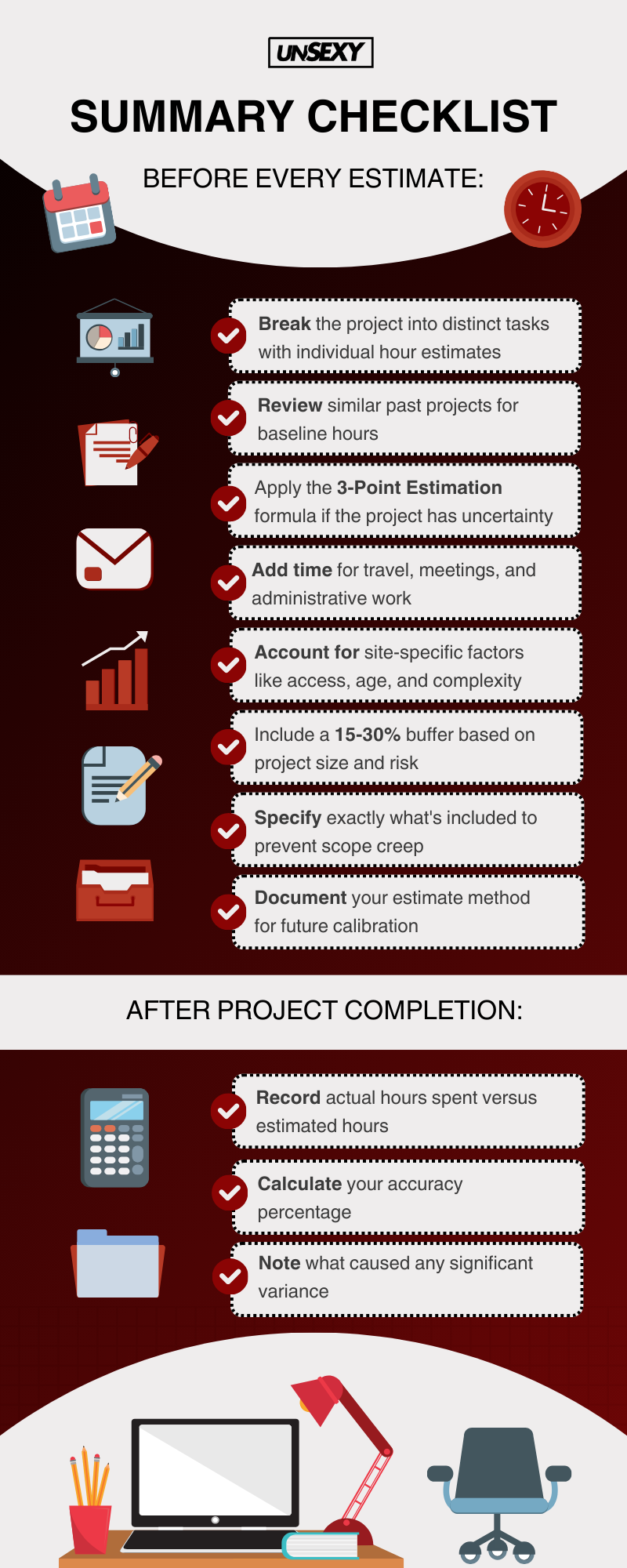
Summary Checklist
Before every estimate:
- Break the project into distinct tasks with individual hour estimates
- Review similar past projects for baseline hours
- Apply the 3-Point Estimation formula if the project has uncertainty
- Add time for travel, meetings, and administrative work
- Account for site-specific factors like access, age, and complexity
- Include a 15-30% buffer based on project size and risk
- Specify exactly what's included to prevent scope creep
- Document your estimate method for future calibration
After project completion:
- Record actual hours spent versus estimated hours
- Calculate your accuracy percentage
- Note what caused any significant variance
- Update your baseline estimates for similar future work
FAQ
What's a realistic accuracy target for estimates?
Aim for 85-90% accuracy with actual hours within 10-15% of estimated hours. Perfect accuracy isn't the goal—consistent, profitable accuracy is. Hitting exactly 100% every time means you're likely over-estimating and losing bids.
Should I include travel time in my labor estimate?
Yes. Travel time is billable labor. Add 30-60 minutes per trip for most service calls, or calculate actual drive time plus 15 minutes for equipment loading and unloading. Many contractors lose 5-8 hours weekly by not billing for travel.
How do I estimate a service I've never done before?
Break it into components you have done before. A new service is usually a combination of familiar tasks. Research industry benchmarks, ask experienced contractors, or add a 30-40% learning curve buffer to your initial estimate.
What if the client wants a "not-to-exceed" price?
Add a larger buffer (30-35%) to your estimate since you're absorbing all overage risk. Specify in writing what changes or conditions would void the not-to-exceed cap. Without this protection, clients can make unlimited changes and still demand the original price.
How often should I update my estimation baselines?
Review quarterly at minimum, monthly if you're actively improving accuracy. Labor efficiency changes over time as your team gains experience, so estimates from two years ago may no longer reflect current productivity.
Ready to take control of your service business pricing? Visit the Unsexy Shop for practical templates and tools that help you estimate accurately, bid confidently, and protect your profit margins.