
What's the Right Way to Charge for Out-of-Scope Work?
Jan 06, 2026
Charge your standard rate (or higher) and get written approval before you start the work.
That's it. No exceptions, no freebies, no "just this once."
The moment a client asks for something outside your original contract, you stop, quote a price, get their signature on a change order, and then—only then—do you begin. Skip this step and you're working for free.
Here's what actually happens when you don't charge: The client emails at 4 PM asking you to "add three more pages to the website." You know it's not quick. You know it wasn't in the contract. But you also know saying no might cost you the client, so you do it anyway.
One "small favor" turns into ten. Before you know it, you're working for free while your actual paying projects fall behind.
This is how contractors, consultants, and service providers lose money. Accountants and bookkeepers in the U.S. lose an average of $6,386 per month on unbilled out-of-scope work. That's $76,632 a year walking out the door.
Charging for out-of-scope work isn't about being difficult. It's about protecting your business from scope creep, the slow bleed of unpaid hours that kills your profit margins.
What Counts As Out-Of-Scope Work?
Anything not in your original contract or proposal.
If it wasn't spelled out in the agreement, it's extra. Simple as that.
Common examples:
- Gold plating. The client asks for new features, enhancements, or additions you didn't plan for. "Can you make the logo spin?" wasn't in the web design contract.
- Advice requests. Quick questions that turn into consultations. "What do you think about this marketing strategy?" might sound casual, but strategy sessions cost money.
- Changed priorities. The client shifts direction mid-project. You agreed to build a blog. Now they want an e-commerce store instead.
- Extended timelines. The project was supposed to take six weeks. Three months later, you're still working on revisions the client keeps requesting.
Your contract is your reference point. Pull it out when a request comes in. If the task isn't listed, it's out of scope.
How Do I Know If A Request Is Truly Out Of Scope?
Ask yourself: Does this task appear in the original agreement?
Walk through this checklist:
- Check the deliverables. What did you promise to deliver? If the new request isn't on that list, it's extra.
- Look at the timeline. Did you agree to unlimited revisions? Or was there a deadline for changes? Work after that deadline is out of scope.
- Review the exclusions. Good contracts specify what's NOT included. If the request matches an exclusion, you charge.
Listen for red flag phrases from clients:
- "While you're at it..."
- "One more thing..."
- "This should be quick..."
- "Can you just..."
These phrases signal scope creep. The client doesn't realize they're asking for extra work. Your job is to make that clear before you do the work, not after.
Should I Say Yes To Out-Of-Scope Requests?
Sometimes yes. Sometimes no. Always charge.
Saying yes to every request burns you out and tanks your margins. Saying no to everything makes you inflexible and hard to work with.
The middle ground: "Yes, and here's what that costs."
When to say yes:
- The work fits your expertise. If you can do it well and it doesn't disrupt your schedule, take it.
- The client is worth keeping. Long-term clients who pay on time deserve some flexibility. Charge them, but maybe offer a slight discount for loyalty.
- It's genuinely quick. If the task truly takes 15 minutes, you might let it slide once. But document it and make clear this is a one-time exception.
When to say no (or bring in help):
- It's outside your wheelhouse. Don't accept graphic design work if you're a copywriter. Subcontract it to someone who knows what they're doing.
- Your schedule can't handle it. If taking on extra work means missing deadlines on existing projects, pass.
- The client is a serial scope creeper. Some clients test boundaries constantly. Shut it down early or they'll walk all over you.
What's The Best Way To Tell A Client It's Out Of Scope?
Be direct but not confrontational.
Bad approach: "That's not in the contract. Pay up or I'm not doing it."
Good approach: "I can definitely help with that. Since it's outside our original agreement, let me put together a quote for the additional work."
Use the "mirror technique." Reflect their request back to them so they see what they're actually asking for:
"So you'd like me to add three more pages to the website, which would include design work, copywriting, and SEO optimization. That wasn't part of our initial scope, but I can accommodate it. Here's what the additional charge would be."
This makes it clear without being aggressive. You're not saying no. You're saying yes with a price attached.
Keep the extras menu ready. Like a restaurant listing side dishes, have a standard rate sheet for common add-ons. When clients ask for something extra, point to the price. No surprises, no negotiation.
How Much Should I Charge For Out-Of-Scope Work?
Your standard hourly rate, minimum. Often more.
Out-of-scope work disrupts your schedule and forces you to context-switch. That's worth a premium.
Pricing options:
- Hourly rate. Bill by the hour for small tasks. Make sure your rate accounts for the disruption to your workflow.
- Project rate. For bigger add-ons, quote a fixed price. This works when you can estimate the time required.
- Rush fee. If they need it fast, charge 25% to 50% more. Quick turnarounds mean dropping everything else.
- Retainer model. Some contractors include a buffer for minor out-of-scope requests in their monthly retainer. Set a cap—maybe 2 hours per month. Anything beyond that gets billed separately.
Don't discount out-of-scope work. Ever. If you discount extras, clients learn they can negotiate everything. Hold firm on pricing.
Do I Need A New Contract For Every Out-Of-Scope Request?
For big changes, yes. For small tasks, a change order works.
Change orders are amendments to your original contract. They outline the new work, the cost, and the timeline. Both you and the client sign before you start.
Use change orders for:
- Recurring requests
- Work that significantly changes the project scope
- Tasks that add weeks to your timeline
Ad-hoc contracts (or supplemental contracts) work for one-time tasks that don't affect the main project much. These are simpler and faster to draft.
Use ad-hoc contracts for:
- One-off requests
- Quick additions
- Tasks that take a day or less
Both documents are legally binding. They protect you if the client disputes the charges later.
For very small tasks—under an hour—you might skip the formal contract and just send an invoice. But document the conversation via email: "Per our call, I'm adding [X] to your project for $[Y]. You'll see this on your next invoice."
How Do I Bill For Out-Of-Scope Work Without Slowing Everything Down?
Automate the process or keep simple templates ready.
Manual billing kills momentum. You're trying to move fast on a client request, but now you're stuck drafting contracts and chasing approvals.
Speed it up:
- Use billing software. Tools that handle proposals, contracts, and invoicing in one place save hours. Set up your out-of-scope rates once, then generate invoices with a few clicks.
- Create standard templates. Have a change order template and an ad-hoc contract template ready to go. Fill in the blanks and send.
- Collect payment upfront. When the client agrees to extra work, charge immediately. Don't wait until the end of the project when they might push back.
- Set clear payment terms. Out-of-scope work gets paid within 7 days, not 30. Fast turnaround means fast payment.
The goal is keeping things moving without losing money. If your billing process takes longer than the actual work, you need better systems.
What If The Client Refuses To Pay For Out-Of-Scope Work?
Stop working immediately.
Once the client agrees to extra charges and you've done the work, they're obligated to pay. If they refuse, you have options.
- Document everything. Every conversation about scope, every email confirming charges, every signed change order. You'll need this if things get ugly.
- Pause the project. Don't deliver any more work—in-scope or out—until they pay what they owe.
- Offer a payment plan. If cost is the issue, break the bill into smaller chunks. Get something rather than nothing.
- Escalate if necessary. Send a formal demand letter. If that doesn't work, small claims court handles contract disputes under $5,000 to $10,000 (depending on your state).
Better to avoid this mess entirely. Get written approval on costs before you do the work. "Per your request, I'll complete [X] for $[Y]. Please reply to confirm before I start."
That one email saves you from unpaid invoices.
How Can I Prevent Scope Creep From Happening?
Write a detailed contract from the start.
The best defense against scope creep is clarity. If your original contract is vague, clients will assume everything's included.
Your contract should specify:
- Exact deliverables. Not "website design" but "5-page website including home, about, services, contact, and blog pages."
- Number of revisions. "Two rounds of revisions included. Additional rounds billed at $[X] per hour."
- Timeline and milestones. "Project completion in 6 weeks with approval deadlines on [dates]."
- What's excluded. "This project does NOT include SEO optimization, content writing beyond provided text, or ongoing maintenance."
- Out-of-scope billing terms. "Additional work requested outside this scope will be billed at $[X]/hour with a change order signed before work begins."
- Internal SOP requirements. Spell out which SOPs govern deliverables, revisions, communication, and change orders so employees follow the same process and nothing falls through the cracks.
The more specific you are upfront, the fewer arguments you'll have later.
Also, train your clients. When they send that first small request, charge for it. This sets the expectation that extras cost money. If you let the first one slide, they'll keep asking.
Running a service business means protecting your time and your rates. If you need help setting up contracts, pricing your services, or managing client relationships, visit our shop to schedule a consultation or sign up for one of our courses. We help contractors and consultants stop working for free and start getting paid what they're worth.
Key Takeaways:
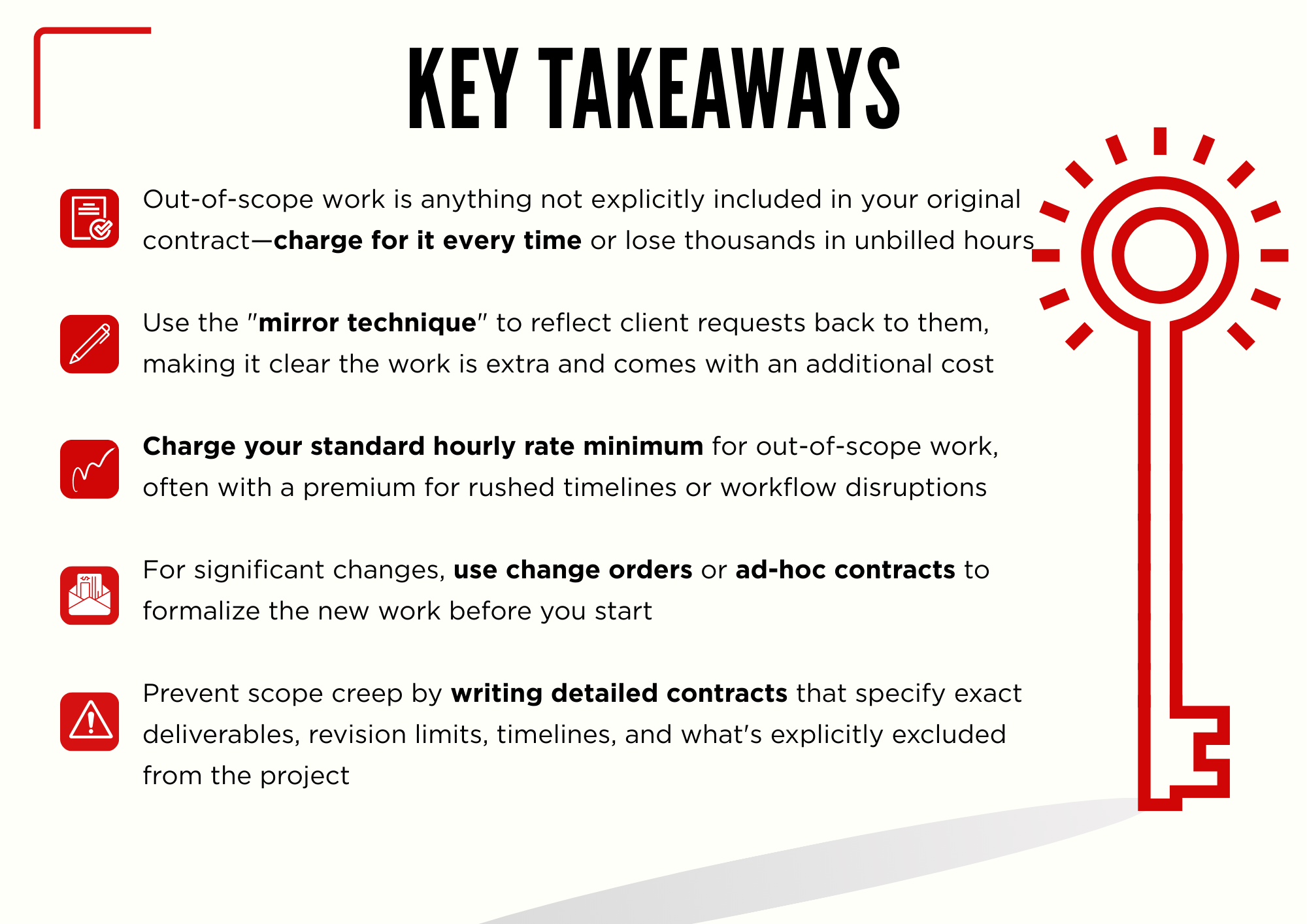
- Out-of-scope work is anything not explicitly included in your original contract—charge for it every time or lose thousands in unbilled hours
- Use the "mirror technique" to reflect client requests back to them, making it clear the work is extra and comes with an additional cost
- Charge your standard hourly rate minimum for out-of-scope work, often with a premium for rushed timelines or workflow disruptions
- For significant changes, use change orders or ad-hoc contracts to formalize the new work before you start
- Prevent scope creep by writing detailed contracts that specify exact deliverables, revision limits, timelines, and what's explicitly excluded from the project