
Should You Underprice Competitors When Starting a Service Business?
Jan 07, 2026
No, underpricing competitors when starting a service business typically damages long-term profitability and attracts the wrong clients. New service businesses should price at market rate or 10-15% below competitors initially, with a clear plan to reach full market pricing within 60-90 days. This approach establishes sustainable operations while avoiding the "budget provider" reputation that's nearly impossible to escape.
Starting with drastically low prices, 30% to 50% below market rate, creates three critical problems: you attract price-sensitive clients who leave at the first opportunity, you lack the revenue to deliver quality service, and you anchor your business reputation at a price point that limits future growth.
Why Underpricing Backfires
When you price significantly below market, you attract clients who prioritize cost over quality. These clients typically:
- Switch providers for minimal savings ($10-20 difference)
- Demand the most time and create the most issues
- Resist any future price increases
- Provide poor referrals to similarly price-focused prospects
Service businesses that start with discounted pricing often see more client churn when attempting to raise prices to market rates. Those who start at market pricing maintain retention through normal business growth. Related strategy insights are discussed in our blog post on how to increase sales for service businesses.
The Profitability Trap
Underpricing creates operational constraints that compound over time. A consultant charging $75/hour needs 27 billable hours weekly to match the revenue of someone charging $100/hour for 20 billable hours. Those extra 7 hours come from somewhere—usually sales, administration, or strategic planning time.
The revenue gap prevents investment in:
- Quality tools and software subscriptions
- Professional development and training
- Marketing that attracts better clients
- Subcontractors or assistants for overflow work
Reputation Anchoring
Your initial pricing creates lasting market perception. Clients, referral sources, and even competitors categorize you as the "budget option." Moving upmarket requires complete rebranding, new client acquisition, and abandoning most of your initial client base.
This aligns with pricing psychology research showing that first impressions strongly anchor perceived value, especially in small business markets.
The Strategic Pricing Framework
Market-Rate Positioning (Days 1-30)
Research 5-7 competitors offering similar services in your market. Focus on providers with 1-3 years of experience, not 10-year veterans. Calculate the average market rate and position at 10-15% below to account for being new.
At this rate, deliver:
- Core service matching competitor standards
- Basic guarantees or revision rounds
- Standard turnaround times
- Professional communication processes
Don't discount rush services, extra revisions beyond standard, or specialized expertise you bring to the table.
Value-Add Differentiation (Days 30-60)
Instead of competing on price, differentiate through:
- Speed: Offer 24-48 hour faster turnaround than larger competitors
- Specialization: Focus on specific industry verticals or use cases others ignore
- Access: Provide direct owner communication without account manager layers
- Customization: Create tailored solutions instead of templated approaches
This connects closely with the unsexy business advantage of specializing in core competencies and solving real client problems, a point we emphasize in posts like How to Start a Lawn Care Business and What Trade Is Right For Me?
Price Normalization (Days 60-90)
For new clients, move to full market rate or 5% below. For existing clients, send 60-day advance notice of rate adjustments. Grandfather current rates for 6 months, then increase 15-20%. Clients who valued your service continue; price-focused clients leaving improves your business quality.
When Strategic Discounting Works
Portfolio-Building Exception
For your first 3-5 clients only, a 20-30% "portfolio rate" makes sense if:
- You receive detailed testimonials and case studies
- You can use work samples in marketing materials
- Clients are in your target industry
- There's a written agreement with clear end date
This is not an ongoing business model—it's a time-limited investment in credibility assets.
Better Than Discounting
Instead of cutting prices, offer:
- Bundled additional services at regular pricing
- Extended payment terms
- Bonus deliverables (templates, guides, extra consulting)
- Priority scheduling for immediate projects
Common Launch Pricing Mistakes
Comparing to Wrong Competitors
Pricing against 10-year veteran firms and going 50% below their rates creates unrealistic expectations. Find businesses at similar stages and price competitively with them.
Ignoring Actual Costs
New service providers often forget monthly expenses:
- Software and tools: $100-300
- Professional development: $50-200
- Marketing: $200-500
- Accounting and legal: $100-200
- Self-employment taxes: 25-30% of revenue
A $50/hour rate leaves roughly $25/hour after taxes and overhead—below sustainable levels in most markets.
No Price Increase Plan
Starting low "temporarily" without defined timelines or triggers for increases traps you at unsustainable rates. Create a written plan with specific dates, client communication templates, and separate pricing for new versus existing clients from month one.
Alternative Competition Strategies
Niche Specialization
Instead of lower prices, offer deep expertise in specific industries. Position as: "I work exclusively with [specific client type] to solve [specific problem]. While general providers charge $X, my focused approach delivers results in half the time."
This mirrors the value propositions we talk about in Want to Start a Business But Have No Ideas?—focusing on solving niche needs rather than competing on price.
Premium Small-Batch Model
Price 10-20% above market average but limit client load to 5-10 active projects. Scarcity creates demand, higher rates enable better delivery, and you attract ideal clients immediately without needing to "graduate" them later.
Partnership Strategy
Did you know that 52.2% of US small businesses say that referrals are the most successful marketing tool for them? Build business through referral relationships with complementary providers. Offer 15-20% referral fees, create bundled services at regular pricing, or split large projects with established firms.
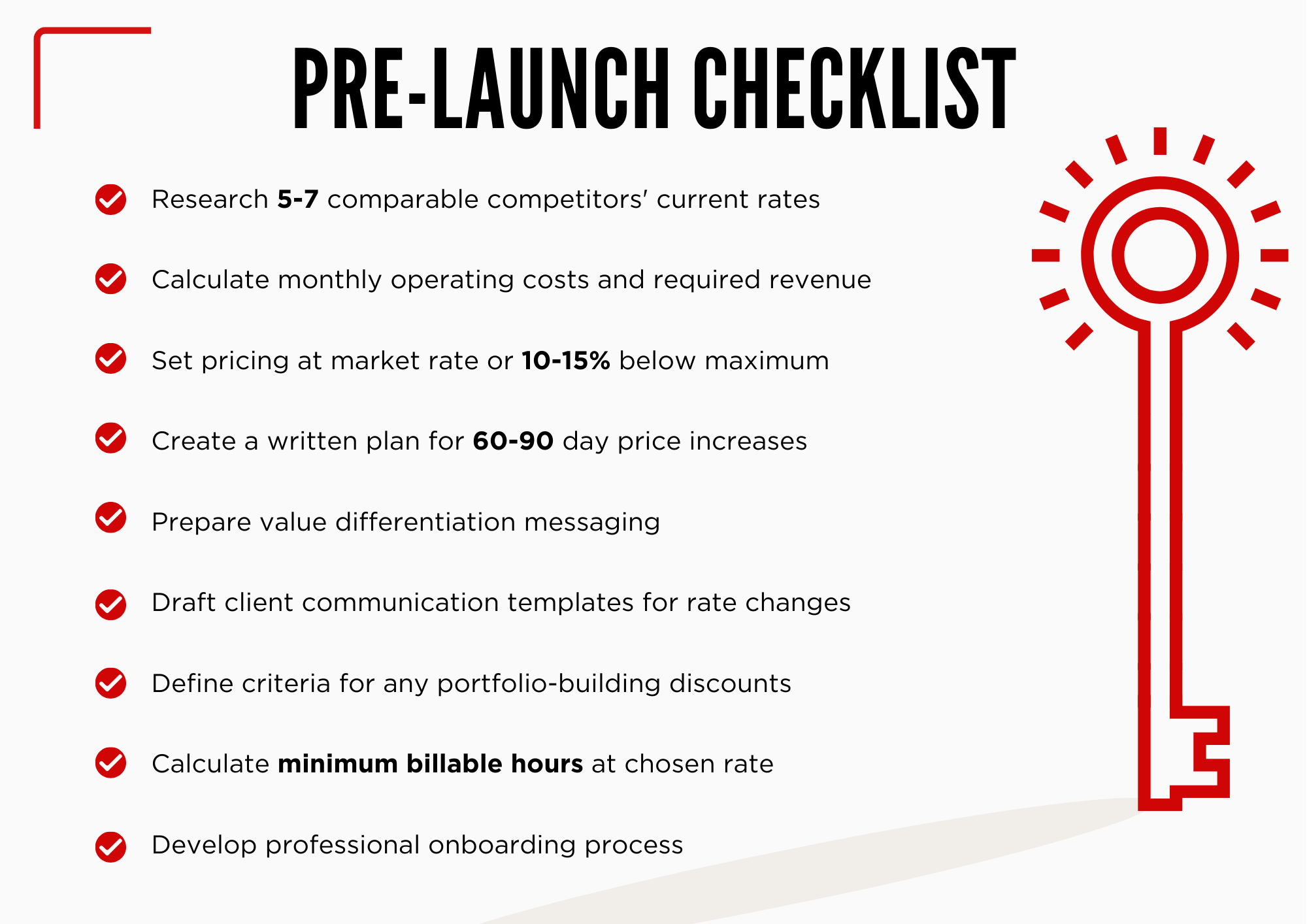
Pre-Launch Checklist
Before setting prices:
- Research 5-7 comparable competitors' current rates
- Calculate monthly operating costs and required revenue
- Set pricing at market rate or 10-15% below maximum
- Create written plan for 60-90 day price increases
- Prepare value differentiation messaging
- Draft client communication templates for rate changes
- Define criteria for any portfolio-building discounts
- Calculate minimum billable hours at chosen rate
- Develop professional onboarding process
FAQ
How much should I charge for my first few clients?
Charge 10-15% below market rate for your first month, then increase to market rate. Calculate market rate by averaging 5-7 competitors with similar experience levels, not industry veterans.
What if competitors charge 50% more than I feel comfortable charging?
You're likely comparing yourself to established businesses rather than similar-stage providers. If rates still seem high after finding appropriate comparisons, the market is telling you the actual value of this work. Underpricing won't help you compete effectively.
How do I raise prices on early clients without losing them?
Provide 60-90 days notice, grandfather current rates for 6 months, then increase 15-20%. Clients who hired you at reasonable rates typically accept moderate increases. Those who came solely for rock-bottom pricing may leave—that's expected and healthy.
Should I match my old employer's prices despite lower overhead?
Price based on market value, not your costs. Lower overhead is your profit advantage, not a reason to undercut the market. Former employer's clients want the same quality with better service or specialization, not cheaper rates.
Building a service business that lasts means getting pricing strategy right from day one. For more frameworks on sustainable business growth, visit the Unsexy Shop for practical tools created by business owners who've faced these exact challenges.