
How Do You Raise Prices on Existing Clients Without Losing Them?
Jan 01, 2026
Raise prices on existing clients by giving 60-90 days advance notice, clearly explaining the value they receive, and offering grandfathering options for long-term clients. The most successful approach combines three elements:
- Honest communication about why rates are changing
- Specific examples of value you've delivered
- Flexible transition options that respect the relationship.
QuickBooks research found that 63% of small businesses increased their prices in 2024. The process works when you position the increase around improved service quality, rising operational costs, or expanded deliverables rather than arbitrary profit increases. Include concrete examples of results you've delivered, acknowledge the partnership, and provide options like annual payment discounts or locked-in rates for early renewals. Clients accept price increases when they understand the reasoning and feel valued in the relationship.
Why Price Increases Don't Automatically Mean Client Loss
Most business owners avoid raising prices because they fear mass client exodus. This fear is largely unfounded when increases are handled properly.
The reality is that clients expect periodic price adjustments. Two to three years between increases is standard across most industries, and quality clients understand that business costs rise over time. When inflation pushes up your labor costs, materials, insurance, and overhead by 8-10% annually, maintaining the same rates actually means you're earning less each year.
The clients who leave over reasonable adjustments often weren't profitable business relationships to begin with. They either required disproportionate support time, consistently pushed back on scope, or were price-shopping from the start.
Think about your own experience as a consumer. When your favorite software tool raises prices by 10% after two years, you might grumble, but you probably don't cancel if it's genuinely useful. You recognize that $10 monthly becoming $11 monthly is hardly worth the hassle of switching. The same psychology applies to your clients.
The difference between a price increase that works and one that fails comes down to communication, timing, and relationship strength. If you've delivered solid results and treat clients with respect, they'll give you the benefit of the doubt.
The 60-90 Day Advance Notice Framework
Timing separates successful price increases from client disasters. Here's the exact timeline that protects retention while implementing necessary changes.
The Planning Phase (90 Days Before)
Start by doing your homework before announcing anything. Calculate your actual cost increases over the past 2-3 years. Look at labor costs, materials, overhead, insurance, and any new tools or certifications you've acquired. This gives you a defensible baseline.
Next, analyze your client list. Sort by profitability and relationship length. Identify which clients have been with you longest, which are most profitable, and which require the most support time. This determines who gets grandfathering options and how you prioritize your communication.
Determine your increase percentage. For most service businesses, 8-15% is standard after 2-3 years. For subscription models, 3-5% annually is acceptable. Anything above 20% requires additional value justification or service expansions.
Prepare specific examples of value delivered for each major client. Pull reports, document outcomes, gather metrics. You need concrete evidence, not vague claims about quality service.
The Communication Phase (60 Days Before)
Send personalized communications 60 days before the effective date. This isn't a mass email blast. Your top 20% of clients should receive individual messages that reference your specific relationship and the results you've delivered together.
For your highest-value clients, schedule phone calls. Email feels impersonal for major partnerships. A 15-minute conversation shows respect and allows you to address concerns immediately.
Your communication should include:
- Personalized greeting with relationship acknowledgment
- Specific examples of value delivered (metrics, results, outcomes)
- Clear statement of new pricing and effective date
- Honest explanation of reasoning
- Grandfathering options if applicable
- Gratitude for the partnership
- Invitation to discuss
Here's what this looks like in practice:
Subject: Important Update About Our Partnership
Sarah,
Over the past three years, our SEO work together has increased your organic traffic by 180% and generated approximately $400K in trackable revenue. We're proud that our partnership has helped you scale from 5 to 15 employees.
As of March 1st, our monthly retainer will be adjusting from $3,000 to $3,400. This change reflects increased costs across labor, tools, and the expanded reporting system we implemented last year.
Because of our strong relationship, we're offering you the option to lock in your current rate through the end of the year if you prepay six months in advance.
We value your partnership and I'm happy to discuss this change. Let's schedule a quick call this week.
This approach acknowledges the relationship, provides context, and offers flexibility. It's respectful without being apologetic.
The Transition Phase (30 Days Before)
Follow up with clients who haven't responded. Some will ignore the initial email hoping it goes away. A gentle reminder 30 days out gives them time to budget while creating urgency.
Address objections individually. Each client's concerns are different, so template responses rarely work. Listen more than you talk, and be willing to negotiate within reason—but don't cave on every objection or you'll undermine the entire increase.
Confirm acceptance and update your systems. Get explicit confirmation from each client that they understand and accept the new rates. Update your billing software, contracts, and invoices before the effective date. Nothing destroys trust faster than billing mistakes during a price change.
Process cancellations professionally. Some clients will leave. Thank them for the partnership, complete their transition thoroughly, and leave the door open for their return. Ask for honest feedback about why they're leaving—you'll learn whether the issue was price, value, or something else entirely.
How to Justify Your Price Increase
The explanation you provide matters as much as the increase itself. Clients accept rate changes when the reasoning makes sense and feels honest.
Value-Based Justification
Start with the results you've delivered. Pull specific metrics:
- Revenue you've generated or saved them
- Time you've saved their team
- Problems you've solved
- Growth you've enabled
For a consulting client, this might sound like: "Over the past two years, the efficiency improvements we implemented saved your team approximately 600 hours annually—roughly $45,000 in labor costs at your average wage."
For a design client: "The rebrand we completed increased your website conversion rate from 1.2% to 3.8%, generating an additional $120,000 in sales last year alone."
Show comparative market rates if you're below average. If competitors charge $150/hour and you charge $100/hour, that's worth noting. You don't need to match their pricing, but it provides context.
Highlight service improvements or additions. If you've added capabilities, upgraded tools, earned certifications, or expanded your team, mention it. "We've invested $15,000 in new project management software that gives you real-time visibility into our work and cuts our turnaround time by 30%."
Cost-Based Justification
Be specific about what's changed financially:
Labor costs might have increased 3.5% over the last year. If you've given raises to keep quality talent (which you should), those costs pass through to clients eventually.
Material and supply costs vary by industry. If you're in construction and lumber costs jumped 40%, that's relevant. If you're in design and your Adobe Creative Cloud subscription increased from $52 to $60 monthly, mention it.
Insurance and regulatory compliance often increase. Professional liability insurance, workers comp, and industry certifications all rise over time.
Software and technology expenses add up. Between project management tools, communication platforms, accounting software, and industry-specific applications, most service businesses spend $500-2,000 monthly on technology.
Be honest without being defensive. "Our operational costs have increased approximately 20% over the past three years, while our rates have remained flat. This adjustment brings us back to sustainable margins while maintaining the quality you expect."
Market-Rate Justification
Reference industry benchmarks when possible. Professional associations often publish rate surveys. "According to the Freelancers Union 2024 rate survey, the average rate for senior consultants in our region is $175/hour. Our increase to $140/hour keeps us competitive while honoring our long-term partnerships."
Show regional adjustments. If you're in a market where the cost of living has jumped significantly, clients understand that impact. "With commercial rents in our area increasing 18% since 2022, maintaining our current location and team requires rate adjustments."
The strongest justification combines all three approaches. You're not just saying "costs went up" (though they did). You're showing value delivered, honest cost increases, and market context. This triple foundation makes objections much harder to sustain.
Common Objections and How to Handle Them
Even with perfect communication, some clients will push back. Here's how to handle the most common objections without undermining your increase.
"I can't afford this increase"
Acknowledge the concern genuinely. "I understand budget constraints are real, and I want to make sure we find a solution that works."
Review the actual ROI they're receiving. Often clients say they can't afford an increase while spending freely on less valuable services. Show them the math: "Your $3,000 monthly investment is generating approximately $12,000 in additional revenue based on the leads we're tracking. That's a 4x return."
Offer payment flexibility if needed. Annual prepayment with a discount, extended payment terms, or phased implementation can ease the transition.
Discuss scope adjustments. "If the new rate doesn't fit your budget, we could reduce to eight articles monthly instead of twelve, which would keep you at $2,800 monthly."
Be willing to part ways professionally. Not every client relationship should continue forever. If they genuinely can't afford your services at sustainable rates, it's better for both parties to acknowledge that reality.
"Your competitor charges less"
Highlight specific differentiators without badmouthing competitors. "That's true—they do charge less. Here's what makes our approach different: we provide dedicated account management, same-day response times, and custom reporting that you can actually use to make decisions."
Discuss apples-to-apples comparison. "When you break down what's included in our package versus theirs, the per-deliverable cost is actually quite similar. We just bundle things differently."
Reference your track record. "Over three years, we've consistently delivered X, Y, and Z. That consistency has value, and switching providers always carries risk and transition costs."
Stand firm on value provided. If you've truly delivered results, don't discount yourself into unsustainability just because someone else charges less. There's always someone cheaper, and clients who only care about price make terrible long-term partners.
"You just raised prices last year"
Acknowledge the timeline honestly. "You're right—we did adjust rates 18 months ago. That adjustment was smaller than this one, and we don't anticipate another change for at least two years."
Explain what's changed. "Since that adjustment, our insurance costs increased by $800 monthly, we added two team members to improve turnaround time, and we invested in new software that's improved our deliverables."
Discuss long-term stability. "We're implementing this increase now specifically so we don't need to do smaller, more frequent adjustments. This puts us on sustainable footing for the next 2-3 years."
Consider the feedback for future timing. If multiple clients raise this objection, it might indicate you're adjusting too frequently. Most businesses should wait 2-3 years between increases unless extraordinary circumstances justify shorter intervals.
"I need to think about it"
Set a specific follow-up date. "Absolutely—take the time you need. Can we reconnect Friday to discuss any concerns?"
Ask what specific concerns they have. "I want to make sure we address anything that's unclear. What aspects do you want to think through?"
Offer additional value documentation. "Would it be helpful if I pulled together a summary of the projects we've completed and results we've achieved? That might help with your evaluation."
Provide a deadline for decision. "The new rates take effect March 1st, so I'll need confirmation by February 15th to ensure uninterrupted service."
Make next steps crystal clear. Don't leave things open-ended. Specify exactly what happens next and when.
What to Do When Clients Actually Leave
Some clients will leave despite your best efforts. Handle these departures professionally because it matters for your reputation and provides valuable data.
Complete their transition thoroughly. Deliver outstanding service right up to the end. Provide all files, documentation, and information they need to move forward. This prevents negative reviews and referrals, and sometimes clients return after realizing the grass isn't greener.
- Ask for honest exit feedback. "I appreciate the time we've worked together. Would you mind sharing what drove your decision? I genuinely want to understand." The response tells you whether price was the real issue or just the stated excuse.
- Leave the door open for future return. "I understand this doesn't fit your budget right now. If circumstances change, I'd be happy to work together again." Many clients boomerang back within 6-12 months after trying cheaper alternatives.
- Update your systems completely. Remove them from billing, update your CRM, adjust your capacity planning. Clean breaks prevent future confusion and billing errors.
- Document the reason internally. Track why clients leave during price increases. This data reveals patterns. If you lose mostly small clients, that's different than losing your biggest accounts.
Now analyze the departure objectively:
- What was their lifetime value? If they paid $2,000 monthly for three years, that's $72,000 in revenue. Compare that to the profit margin at old rates versus new rates. Sometimes keeping them at old rates is still profitable.
- Were they actually profitable at old rates? Calculate the time you spent on their account, support requests, revisions, and meetings. Some clients feel profitable until you track hours carefully. If they consumed 20% of your team's time but generated 8% of revenue, losing them improves your business.
- Did they require disproportionate support? The clients who email daily, request constant changes, and miss deadlines create hidden costs. Their departure might free up capacity for better clients.
- What percentage of revenue did they represent? If they were 5% of your revenue, that's manageable. If they were 40%, you have bigger business problems than a price increase—you were dangerously dependent on one client.
- Would matching competitor rates still be profitable? Sometimes the math simply doesn't work. If competitors are charging unsustainable rates to grab market share, you can't match them without destroying your business.
Here's the truth: If clients leaving over 10-15% increases represent less than 20% of your revenue, the increase was successful. You've shed unprofitable relationships and positioned yourself for sustainable growth. That's not failure—that's smart business.
Mistakes That Guarantee Client Loss
Certain approaches to price increases destroy retention rates even when the increase itself is reasonable. Avoid these errors.
- Surprise increases on invoice day kill trust instantly. A client who receives an invoice that's 15% higher than expected with no warning feels trapped and disrespected. Even if they eventually pay, the relationship is damaged. This approach generates the lowest retention rates—often below 60%—because it creates an adversarial dynamic.
- Vague or dishonest reasoning makes clients suspicious. Saying "market conditions require adjustments" means nothing. It's corporate speak that signals you don't respect them enough to be honest. Clients see through generic explanations and assume you're just being greedy. Be specific about what changed or don't explain at all.
- Mass email without personalization shows lack of relationship value. Sending identical rate increase emails to everyone makes clients feel like "just a number." Your biggest accounts especially expect direct, personal communication. A generic email to a client who's paid you $150,000 over three years is insulting.
- Defensive or apologetic tone undermines your authority. If you apologize excessively for raising prices, clients assume the increase isn't justified. Phrases like "We're so sorry but we have no choice..." or "We apologize for any inconvenience this causes..." signal weakness. State the change clearly and confidently without excessive apology.
- Negotiating away increases too easily creates terrible precedent. If you immediately drop your rates when the first client pushes back, you signal that the increase wasn't necessary. Word spreads quickly—clients talk to each other. Soon everyone is demanding the same concession. Stand firm on your increase for most clients, making exceptions only for truly strategic relationships.
The Annual Review Approach (Prevention Strategy)
The best way to handle price increases is to make them expected rather than surprising. Build pricing flexibility into your client relationships from the start.
Schedule annual partnership reviews with every major client. Block out 30-60 minutes to review what you've accomplished together, discuss upcoming goals, and talk about the relationship. These aren't sales calls—they're genuine check-ins about mutual value.
Document value delivered throughout the year. Don't wait until price increase time to compile results. Track wins, metrics, and outcomes quarterly so you have a running record of impact.
Discuss pricing during annual reviews, not via email. When pricing conversations happen face-to-face (or video-to-video) as part of a broader partnership discussion, they feel natural rather than confrontational.
Build increase expectations into initial contracts. Include language like: "Annual rate reviews occur each January. Adjustments reflect service value, market conditions, and operational costs. Clients receive 60 days notice of any changes."
Reference rate adjustment clauses during onboarding. Don't hide the clause in page 12 of your terms. Mention it explicitly: "Just so you know, we review rates annually. Most years there's no change, but it gives us flexibility if our costs increase significantly."
This approach normalizes pricing conversations, removes the surprise element, and creates accountability on both sides. Clients who go through annual reviews rarely object strenuously to reasonable increases because they've seen the value consistently and know adjustments are part of the relationship.
Industry-Specific Considerations
Different business models require slightly different approaches to price increases.
Service businesses
Service businesses like agencies, consultants, and contractors should tie increases to deliverable expansions when possible. "We're adding monthly strategy sessions and expanding reports, which increases your retainer from $5,000 to $5,750." This frames the increase as added value rather than just higher cost.
Use project completion as natural transition points. When one project ends and another begins, introduce new pricing. This feels less disruptive than mid-engagement changes.
Emphasize results and case studies. Service businesses sell outcomes, so lead with the results you've delivered when justifying increases.
Subscription and SaaS businesses
Subscription and SaaS businesses should grandfather longer to avoid churn spikes. Monthly subscriptions are easier to cancel than service contracts, so the friction to leave is lower. Offering 6-12 months at current rates eases the transition.
Use feature tier migrations to justify increases. "We're moving all Pro plan users to Enterprise features at the Pro price for 90 days, then adjusting Pro pricing to $149 monthly to reflect these additions."
Leverage annual billing incentives heavily. "Lock in current pricing by switching to annual billing before March 1st" converts monthly subscribers to annual contracts while easing the immediate price increase concern.
Retail and Product businesses
Retail and product businesses should phase increases by product category. Raising everything at once creates sticker shock. Adjust one category monthly over a quarter to spread the impact.
Use COGS (cost of goods sold) data transparently. When raw material costs jump 30%, customers generally understand price increases. Show receipts if needed.
Offer bundle deals at old pricing temporarily. "Buy three items and get 2023 pricing through end of month" moves inventory while giving customers a transition window.
Frequently Asked Questions
How much can I increase prices without losing clients?
Businesses can often successfully implement 8-15% increases with proper notice and communication. Increases above 20% typically require additional value justification or significant service expansions. Annual increases of 3-5% to match inflation are generally accepted without major objection. The percentage matters less than the communication, timing, and value you've demonstrated.
Should I raise prices for all clients at once or phase it in?
Raise prices for all clients with the same effective date to avoid creating confusing pricing tiers and administrative complexity. However, offer different grandfathering options based on relationship length and client value. Phasing creates operational headaches, tracking multiple clients on different rate schedules becomes unmanageable, without providing significant retention benefits.
What if my biggest client threatens to leave over the increase?
First, calculate whether they're actually profitable at current rates when you factor in support time, meetings, revisions, and opportunity cost. If yes, consider keeping them at current rates temporarily while actively diversifying your client base so they represent a smaller percentage of revenue. If no, let them leave professionally—one client shouldn't hold your entire business hostage to unsustainable pricing. Many businesses discover their "biggest client" was actually their least profitable once they run the numbers.
How often should I raise prices?
Every 2-3 years is standard for most service businesses. Annual increases are acceptable for subscription models if kept to 3-5%. Avoid raising prices more than once per year except in extreme circumstances like dramatic cost events or significant service additions. More frequent increases create "adjustment fatigue" and make clients question your pricing strategy.
Can I raise prices mid-contract?
Only if your contract includes a rate adjustment clause that explicitly allows it. Without contractual basis, attempting mid-contract increases damages trust and may create legal issues. Wait until contract renewal for changes. Use renewal periods as natural price adjustment points—clients expect to discuss terms when renewing, making the conversation easier.
Pricing strategy is just one piece of building a sustainable business. For more resources on running a profitable operation without breaking the bank, check out the practical tools and guides in the Unsexy Shop—created by business owners, for business owners who value substance over flash.
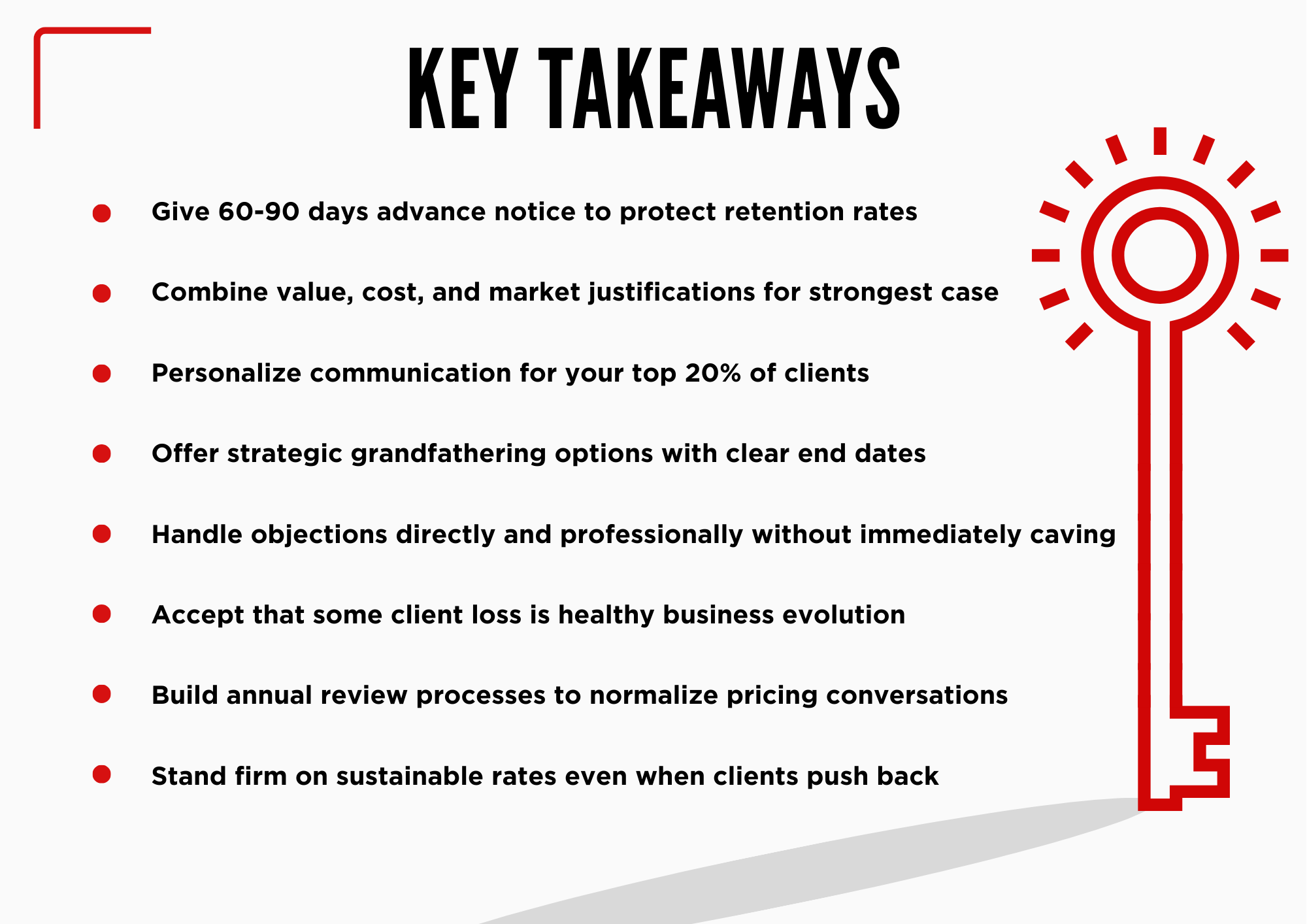
Key Takeaways:
- Give 60-90 days advance notice to protect retention rates
- Combine value, cost, and market justifications for strongest case
- Personalize communication for your top 20% of clients
- Offer strategic grandfathering options with clear end dates
- Handle objections directly and professionally without immediately caving
- Accept that some client loss is healthy business evolution
- Build annual review processes to normalize pricing conversations
- Stand firm on sustainable rates even when clients push back