
How to Start a Food Truck Business: The Unsexy Truth About Mobile Food
Dec 04, 2025
Food trucks look amazing on Instagram. Trendy tacos at sunset, lines of customers stretching down the block, #foodtruck #entrepreneur hashtags everywhere.
The reality? You're standing in a metal box that's 110 degrees in summer, your back hurts from hunching over a flat-top grill, and you just spent $17,000 on permits in Boston before serving a single customer.
The food truck industry hit $2.7 billion in 2017 and is annually. But here's what nobody mentions: most food truck operators take home less profit than they would managing a car wash or pressure washing business with half the headaches.
Food trucks can work—some bring in $500,000 in annual revenue. But you need to understand the actual costs, realistic timelines, and whether this beats other business options before you sign an $80,000 loan for a used truck.
What Does It Really Take to Start a Food Truck Business?
Starting a food truck business requires $50,000 to $250,000 in startup capital, 6-12 months of preparation time, and navigating a maze of permits that varies wildly by city. Most operators work within $70,000 to $130,000 to get on the road.
Minimum viable start: $50,000 gets you a used truck, basic equipment, permits in a friendly city like Denver or Portland, and three months runway.
Realistic budget: $100,000 covers a decent used truck, proper equipment, permits in an average city, commissary kitchen deposit, and six months operating expenses.
Premium route: $150,000+ buys you a custom new truck, top equipment, permits anywhere, and enough buffer to survive your first year.
The real kicker? These numbers only get you to opening day. They don't account for months of negative cash flow while you build a customer base.
The Math Everyone Ignores: Revenue vs. Actual Profit
Articles love throwing around that $500,000 revenue number for successful food trucks. The average revenue for food truck in 2025 in the US is actually $346,000.
So let's run the optimistic math.
A food truck hitting $500,000 in annual revenue typically operates 250 days per year, serving 150-200 customers daily at $12-15 average ticket. That's top tier—most trucks do half that.
Now the profit reality:
- Food costs: 28-35% ($140,000-$175,000)
- Labor: 25-30% ($125,000-$150,000)
- Operating costs (gas, maintenance, commissary): 15-20% ($75,000-$100,000)
- Permits and insurance: $30,000-$50,000 annually
- Marketing and supplies: $20,000-$30,000
That $500,000 leaves you with $30,000-$80,000 in actual profit. Before taxes.
Food trucks can hit 6-10% profit margins if you control costs well, but that's still $30,000-$50,000 take-home on $500,000 in sales. Compare that to pressure washing: $50,000 startup, less regulation, 20-30% margins, and you're not standing in a hot truck for 12 hours.
The Permit Nightmare: What $28,000 Actually Buys You
Research from the U.S. Chamber of Commerce shows food truck owners spend an average of $28,276 on permits and licenses in their first year.
Five main permit categories you'll face:
- Administrative: Business license, EIN, sales tax permit
- Health/Food Safety: Mobile food facility permit, health permit, food handler certifications
- Vehicle: Commercial vehicle registration, inspection certificates
- Safety/Hazard: Fire safety permit, propane storage permits
- Zoning: Parking permits, location-specific permits
Miss one, and you're looking at fines, shutdowns, or both.
Commissary Kitchens: The $2,000/Month Requirement Nobody Emphasizes
Most cities legally require food trucks to operate from a licensed commissary kitchen. You can't prep food at home, and your truck doesn't have enough space anyway.
A commissary kitchen is a licensed commercial kitchen that multiple food businesses rent for prep work, storage, and equipment access.
Real monthly costs:
- Major cities: $1,000-$2,500/month
- Mid-size markets: $500-$1,200/month
- Small towns: $300-$800/month
That's $6,000-$30,000 annually just for the right to legally prep your food. This cost never goes away as long as you operate.
Truck and Equipment: The $60,000-$150,000+ Reality
Custom New Trucks: $75,000-$150,000 Built to your specs, 3-6 month build time, full warranties, zero hidden problems.
Used Food Trucks: $40,000-$80,000 Ready immediately, equipment installed, but unknown maintenance history. That $50,000 "deal" truck might need another $10,000-$20,000 in repairs within the first year.
Food Trailers: $20,000-$60,000 Lower cost, no engine maintenance, requires separate tow vehicle.
Equipment costs: Budget $20,000-$45,000 for a full kitchen if starting from a shell. Core cooking equipment runs $8,000-$15,000, refrigeration $3,000-$8,000, required systems (sinks, water tanks, ventilation, fire suppression) $4,000-$10,000, plus POS system and initial inventory.
Operating Costs: The Monthly Burn Rate
Fixed costs (regardless of sales)
Commissary kitchen ($500-$2,500), insurance ($400-$800), truck payment ($800-$1,500), permits ($100-$500), software and services ($300-$750). Total fixed: $2,100-$6,050/month
Variable costs
Food costs (28-35% of revenue), labor (25-30% of revenue), fuel ($400-$1,000), propane ($100-$300), packaging (3-5% of revenue), marketing ($200-$500), maintenance ($200-$800).
Most food trucks need $15,000-$25,000 in monthly revenue to cover costs and pay the owner a modest salary. That's $600-$1,000 per operating day.
The Unsexy Realities: What It's Actually Like
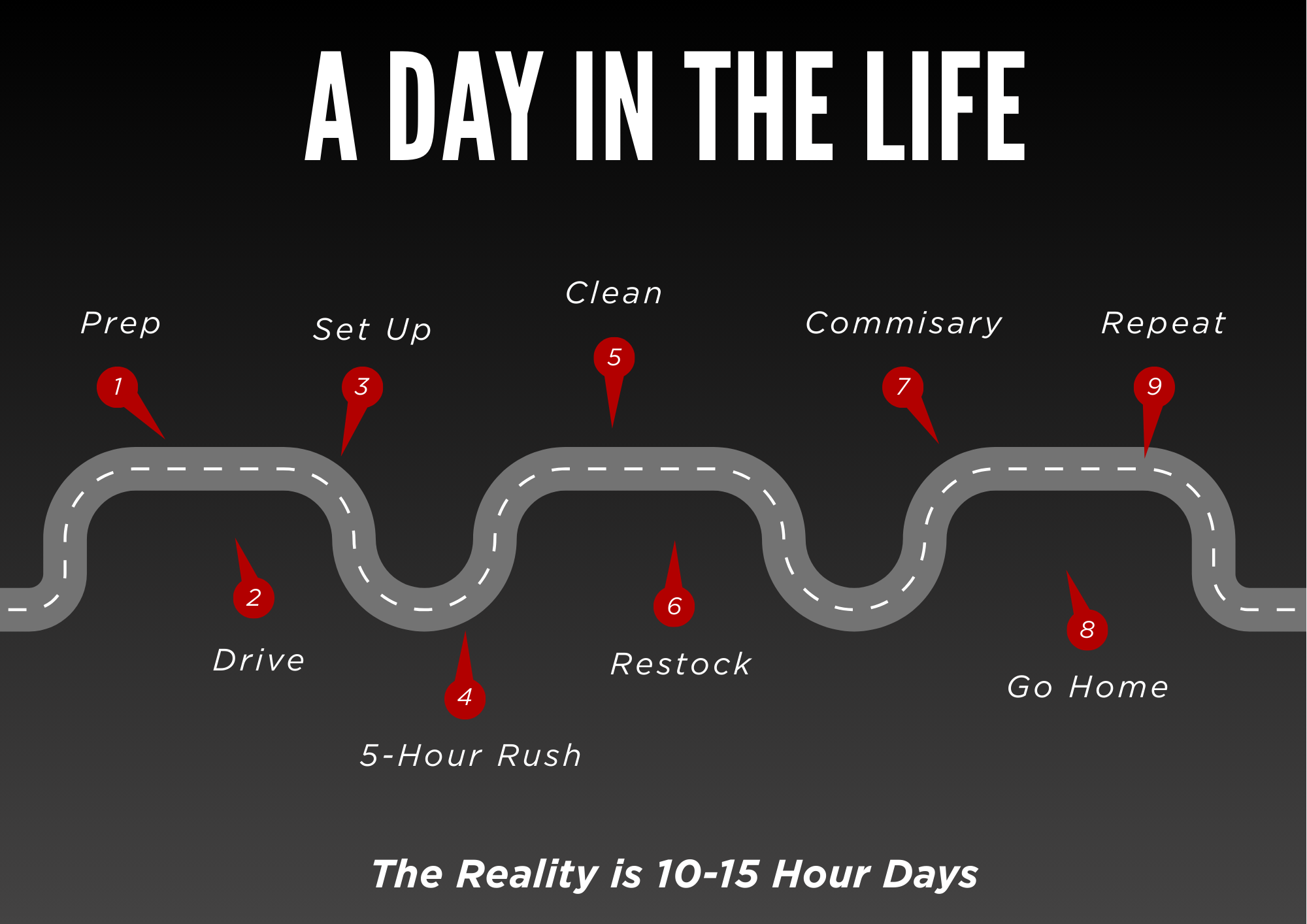
The physical toll: Standing 10-14 hours, working in 110°F+ heat in summer, freezing in winter, lifting 50-pound boxes daily, repetitive stress injuries common.
Weather determines your income: Rain cuts revenue, winter months see drops in cold climates. One bad weather week destroys monthly targets. No sales still means paying fixed costs.
Work-life balance issues: Weekends and evenings are peak revenue times. Miss family events, social gatherings, kids' activities. Vacation means zero revenue. First 2-3 years require near-constant presence.
Depreciation reality: Trucks lose 20% of their value over the first four years, 15% annually after. Equipment needs replacement every 5-7 years. Major repairs every 2-3 years can cost $3,000-$8,000.
This isn't meant to discourage, it's meant to prepare. Realistic expectations beat the "follow your passion" illusion that leaves operators burned out and broke within two years.
How Food Trucks Compare to Other Unsexy Businesses
Before committing $100,000 to a food truck:
Pressure washing: $5,000-$15,000 startup, 60-80% margin potential, $60,000-$150,000 salary potential, minimal regulation, high scalability. Better margins, lower startup, easier scaling than food trucks.
Cleaning business: $2,000-$10,000 startup, 20-25% margin potential, $50,000-$100,000 salary potential, minimal regulation. Much lower startup, similar margins, less romantic.
Vending machines: $3,000-$20,000 for 5-10 machines, 20-25% margin potential, 10-15 hours/week involvement, highly scalable. More passive, lower margins, less exciting.
The food truck advantage: Creating an experience, customer interactions, creative menu freedom, visible brand.
The food truck disadvantage: Lower margins than service businesses, highest regulation, location-dependent revenue, physical toll, less scalability.
Choose food trucks if experience and customer interaction matter. Choose other unsexy businesses if profit-per-hour is your primary metric.
Success Rates and Failure Reality
Approximately 60% of food trucks close within three years. That's a 40% survival rate—better than restaurants (30%) but worse than traditional service businesses (50%).
Common failure reasons:
- Undercapitalization: Ran out of money before profitability, didn't account for slow winter months
- Location problems: Couldn't secure consistent high-traffic spots, parking restrictions tightened
- Operational inefficiency: Menu too complicated, food costs too high (over 40%), staffing problems
- Regulatory issues: Lost permits, failed inspections, couldn't afford renewals
- Owner burnout: 80-hour weeks unsustainably, health problems, relationship issues
Trucks that survive past year three have: consistent prime locations locked in, 20% net profit margins, streamlined operations under 60 hours/week, and hired staff or a partner sharing workload.
Should You Start a Food Truck Business?
Ideal candidates: Strong food service experience (3+ years), $50,000-$100,000 available capital, physically capable of demanding work, located in food truck-friendly cities, strong marketing skills, comfortable with financial uncertainty.
Poor fit indicators: No food service background, limited capital (under $40,000), health issues limiting physical work, located in expensive permit cities, expecting quick profitability, need consistent 9-5 schedule.
Food trucks can generate $30,000-$80,000 in annual profit for owner-operators working 50-60 hours weekly. That's $12-$16 per hour when you break it down—less than many management positions pay.
The appeal is being your own boss, creative control, and customer interaction. If those matter more than maximizing profit-per-hour, food trucks might work.
If profit-per-hour is your priority, pressure washing, cleaning businesses, or other unsexy service operations will make you more money with less headache.
Getting Started: Your First Steps
- Week 1-2: Research your city's permit requirements, call the health department, scout commissary kitchens, calculate realistic startup costs, evaluate available capital.
- Week 3-4: Visit 10+ operating food trucks, talk to owners, test menu concepts, work a day in an existing truck if possible, calculate realistic revenue.
- Month 2: Write basic business plan focused on numbers, decide if numbers work for your goals, form LLC and get EIN if yes.
- Month 3: Secure funding, start permit applications, research available trucks, lock in commissary kitchen.
- Months 4-6: Purchase truck, complete equipment installation, finish permits and inspections, hire staff, build social media.
- Months 7-12: Soft launch at small events, refine operations, secure regular locations, scale marketing, optimize for profitability.
Stay realistic about timelines and costs. Assume everything takes longer and costs more than planned. Build buffer into your budget and expectations.
The Bottom Line
Food trucks aren't the romantic escape from corporate life that Instagram suggests. They're hard work, tight margins, and constant hustling.
For the right person, someone who loves food, connects with customers, and doesn't mind physical work, they can provide independence and decent income.
Just know what you're getting into. The $500,000 revenue numbers sound great until you realize most goes to food costs, labor, permits, and truck expenses. The "be your own boss" freedom sounds amazing until you're working more hours than you ever did as an employee.
Food trucks work best as a business, not a passion project. Treat it like a profit center, control costs obsessively, and scale strategically. The trucks that survive approach it this way.
The ones that fail usually followed their passion straight into bankruptcy.
Ready to explore other unsexy but profitable business opportunities? Visit Unsexy Businessmen for practical advice on businesses that actually make money without the hype. We focus on real profitability, car washes, pressure washing, cleaning services, and other businesses that build wealth without venture capital or trendy hashtags.